When Guybrush Threepwood meets a better swordsman, swinging harder gets him nowhere. He needs to work out what to say. That duel explains why Monkey Island still has something to tell us about games. Lucasfilm’s pirate adventure made a line of dialogue part of the action, and that idea could travel well beyond the Caribbean.
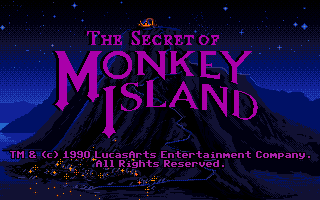
A pirate world you could step into
In the late 1980s, game designer Ron Gilbert read Tim Powers’s novel On Stranger Tides. He later singled it out as an inspiration for the pirate setting and its mix of seafaring and the supernatural. Disneyland supplied the atmosphere. Writer Dave Grossman recalls Gilbert pitching a version of the Pirates of the Caribbean ride where visitors could step off the boat, talk to people and explore. In the game, that idea becomes places like Mêlée Island, with a tavern full of people who have their own ideas about who qualifies as a pirate. Ron Gilbert on the novel · Lucasfilm’s team interview
The tavern that teaches you the rules
One of the first things Guybrush does is tell a stranger that he wants to become a pirate. It is an optimistic opening line for someone who has just landed on an island where almost everyone has an opinion on his qualifications. In the tavern he learns that his dream requires three trials. The tasks give the player an idea of what needs doing, and the islanders supply clues from their own corners of the story. You start to understand the place by asking questions. To get the story moving, Guybrush often has to find the right person, get them talking and work out what they actually meant.
That is also how the series makes its pirate world feel inhabited. Guybrush can treat piracy like a job application, ghosts can take their professional troubles deadly seriously and a salesman can talk about the boat he wants to shift as though it were the safest investment in the Caribbean. Several kinds of story can fit in the same scene. Anyone drawn to pirate adventures gets harbours after dark and forbidden treasure. Comedy fans get to watch a man enter a room with a plan that immediately gets worse on contact with another person. Both readings fit the first game. It helps explain why the setting works even for people who have never bothered to learn port from starboard.
A joke the player has to get
Game designer Noah Falstein describes the team looking for a way to make sword fighting funny. In Errol Flynn films, a sharp reply could give a duellist the upper hand in a scene. The team built the duel around that principle. When a pirate insults Guybrush, the player must choose a line that turns the insult back on its speaker. Part of the pleasure is working out why the reply lands. Noah Falstein in Game Developer, March 2006
That suited an adventure built around curiosity. In his 1989 design essay, Gilbert argued that players should be able to try things without losing substantial progress over a mistake. On Mêlée Island, the inexperienced Guybrush often gets the last word because you listened, experimented and remembered a good line. Ron Gilbert’s design essay
The button that was also a joke
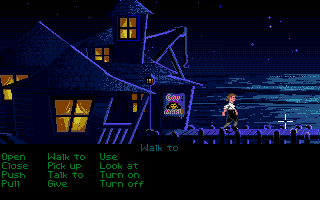
An Amiga screenshot of the first game shows verbs below the scene. You can look at something, talk to someone or try to use whatever you are already carrying. It is an unusually open way to present a story. In a novel, you meet the line the author has chosen. Here you might choose a sensible answer, a boast or something that leaves Guybrush in a worse bargaining position than he was in before he opened his mouth. The writers set the possibilities. The player gets to discover which ones turn out to be funny. A detour you chose can become the part of an evening with the game you remember best.
Insult sword fighting builds on a habit the game has already taught you. Guybrush hears words and needs to understand what they do. An ordinary duel rewards a deft hand on the controls. This one asks you to remember what people have said. Reading becomes part of the action, with a clear cue for when to act. Your opponent insults you, you pick a reply and the game shows whether it works. Getting it wrong can give you something useful for the next encounter. Comedy becomes something you can practise, a little like telling the same dreadful joke at dinner until you finally find a version that lands.
Puzzles that play a part in the story
Gilbert’s design essay also considers what players need to know about their goal and how a solution ought to make sense in hindsight. That matters to a comedy adventure. A solution can be improbable and still feel obvious when you finally see the connection. The player can test the edges of such a world. Sometimes an odd combination produces a joke. Sometimes it shows how a character thinks, and sometimes it opens the next part of the story. If you stay stuck for too long, the comedy struggles to do its job. The pace disappears even if the individual lines are funny. Ron Gilbert’s design essay
That balance makes Monkey Island interesting beyond games. A comedy film can cut to a reaction at the moment the director wants. In an adventure game, you can walk on, stand still or talk to the wrong person first. A good script makes enough of those routes worth a moment of your attention. A line that seems to be a passing joke can have another job later on. You suddenly realise that the silly thing you just heard was also a clue. That moment rewards you for paying attention while the game was busy being a comedy.
Six games and several ways to tell an adventure
The Secret of Monkey Island and Monkey Island 2: LeChuck’s Revenge came first. The Amiga editions in Vujer’s archive date from 1991 and 1992 respectively. The series continued with The Curse of Monkey Island (1997), Escape from Monkey Island (2000) and the episodic Tales of Monkey Island (2009). When Return to Monkey Island arrived in 2022, Gilbert and Grossman were back to help shape the story. Guybrush returned to familiar places with new art and an updated interface. Series chronology · Lucasfilm on the return
The games also experimented with letting the player shape the pace. In LeChuck’s Revenge, game scholar Karen Collins describes how the instrumentation in the port of Woodtick changes as Guybrush boards different ships. The melody holds the place together while the route the player takes determines how it sounds. Like the dialogue, the music lets the world respond to what you do. Karen Collins, Game Sound, p. 56
From floppy disks to cartoons and back to the island
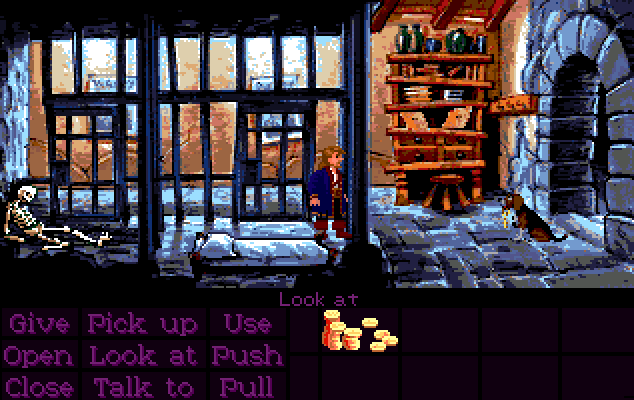
It is worth keeping the editions straight. Lucasfilm dates the original debut to 1990, while Vujer’s Amiga entry is dated 1991. That distinction matters when someone remembers a particular interface, colour palette or experience on their home computer. We can follow the first two games in their Amiga forms here. The first gives us a harbour at night and the relationship between the scene and the command line. In the second game’s jail screenshot, items have their own inventory pictures. If you played either edition with a friend sitting beside you, that interface helped decide what they could spot and what advice they could start dispensing. Lucasfilm on the series’ beginnings
The later games show how much could change while Guybrush’s comic relationship with the world stayed familiar. The Curse of Monkey Island let cartoon art and voices carry part of the comedy. A pause or a tone of voice could now be built into the delivery. Escape from Monkey Island moved to three-dimensional presentation and different controls, while Tales of Monkey Island broke its story into episodes. Part of its rhythm comes from what is saved for the next instalment. Throughout the series, Guybrush keeps arriving with a grand plan and meeting some perfectly ordinary person with a devastating follow-up question. The editions and their designs
By the time Gilbert and Grossman returned in 2022, some players remembered old lines and others had different expectations about how easy a game should be to pick up. A new interface changes the habits a game can assume. Someone who already knows to look at an item and think about which verb fits rarely needs help with that sequence. A newcomer also needs to see what can be done before getting to the interesting question of why it might help. Return shows one way to carry on a tradition. The tone and appetite for experimentation can survive a change in the way you point and click. Lucasfilm on the design of Return
The series through the years
- 1987
On Stranger Tides
Tim Powers’s novel gives Ron Gilbert a way into a supernatural Caribbean. - 1990–91
The Secret of Monkey Island
The series debuts in 1990. Vujer’s Amiga edition is dated 1991. - 1991–92
Monkey Island 2: LeChuck’s Revenge
The sequel expands the world. The Amiga edition arrives in 1992. - 1997
The Curse of Monkey Island
Cartoon art and voices become part of the comedy. - 2000
Escape from Monkey Island
The series moves to a three-dimensional presentation. - 2009
Tales of Monkey Island
Guybrush’s adventure is told in episodes. - 2022
Return to Monkey Island
Gilbert and Grossman return to the series. - 2023
The Legend of Monkey Island
Rare lets Sea of Thieves players sail to Mêlée Island.
How critics received the games
The British Amiga press welcomed The Secret of Monkey Island. Trenton Webb gave the Amiga edition 92 percent in issue 23 of Amiga Format in June 1991. He enjoyed the animation, humour and demanding puzzles. He also complained about disk swaps, jerky scrolling and menus that sometimes led to a misplaced click during sword fights. The duel that showed what the game could do with dialogue could also involve waiting for a floppy disk. Trenton Webb’s Amiga Format review
When Monkey Island 2: LeChuck’s Revenge reached the Amiga the following year, Amiga Format gave it 95 percent. Gary Penn awarded 90 percent in issue 15 of Amiga Power. He praised the scenery, jokes and interface and objected to the number of disk swaps. He also found that music played too seldom on the one-megabyte Amiga he tested. That qualifies the story of the music in Woodtick. Knowing what the sound system could do is one part of understanding how it felt on the machines people actually played on. Amiga Format’s score · Gary Penn’s Amiga Power review
Three decades later, Nintendo Life gave the Switch edition of Return to Monkey Island 9 out of 10. Reviewer Roland Ingram singled out the way the new interface made rooms easy to investigate and how well the art worked in motion. Read Webb and Ingram side by side and you get a sense of what changed. Webb was frustrated by sending Guybrush the wrong line and Ingram enjoyed discovering what he could interact with. Both were judging how it felt to make the character do something, with three decades of different expectations packed into that click. Roland Ingram’s Nintendo Life review
How many copies did they sell?
An often-cited figure for Monkey Island 2 puts sales at about 25,000 copies and is attributed to Tim Schafer in issue 204 of Edge from 2009. It is a retrospective figure, with no clear platform or regional breakdown in the account that cites it. It cannot be read as an Amiga-only sales figure or a confirmed lifetime total. For The Secret of Monkey Island, a separate, verified sales figure for the Amiga edition is also unavailable. Edge issue 204 in the Video Game History Foundation archive · The reported estimate and its reference
For the next two games, figures with a clearer scope are available. Market researcher PC Data reported that The Curse of Monkey Island sold 52,049 copies in the United States by the end of 1997, and that the computer edition of Escape from Monkey Island sold 55,275 copies in the United States by the end of 2000. The two figures cover defined periods and offer a look at the American market around each launch. Tales of Monkey Island offers a different kind of measure. Telltale called it the studio’s bestselling episodic series to date in a 2010 Game Developer retrospective, without providing a unit count in that article. PC Data for Curse · PC Data for Escape · Telltale’s Game Developer retrospective
A month after the 2022 launch, Devolver Digital called Return to Monkey Island the fastest-selling game in the series. Its 2022 annual report said the game had exceeded expectations. These statements describe the strength of the launch. Comparing the number of copies sold with the earlier games would require a published unit count. The comeback’s strong reviews and strong opening are both documented, with different evidence for each. Devolver’s announcement as reported by Nintendo Life · Devolver’s 2022 annual report
From a pirate tavern to a murder on a train
Adam Riches of Robust Games has described Loco Motive as a blend of Monkey Island and Agatha Christie’s Murder on the Orient Express. In the later game, a bumbling detective carries the comedy. Riches also points to newer controls and ways of playing in Return to Monkey Island as an influence. What travelled into a different kind of story was the mix of a familiar genre, a protagonist out of their depth and problems that reward curiosity. Nintendo Life interview with Adam and Joseph Riches
In 2023, that legacy took a different route. Rare and Lucasfilm Games created a new Monkey Island story within Sea of Thieves, where players could sail to Mêlée Island and go ashore. It is an unusually literal return to the old idea of stepping off the boat. Loco Motive shows how the comedy could move to a train. Sea of Thieves shows why so many people wanted to go back to that particular pirate tavern. Rare on The Legend of Monkey Island
When an idea gets a new address
There is another example between the original voyage and Guybrush’s return. In a 2015 demonstration of the Thimbleweed Park interface, Gilbert pointed to its resemblance to Monkey Island. His comparison was specific and concerned choosing verbs and noticing what could be examined. A way of working carried on with one of the people who helped shape it. In Loco Motive, it reached another developer. It appears in the choice to make a mystery into a comedy and in the effort to show newcomers where to get help when they are stuck. You can recognise the method even when the train is headed nowhere near a pirate island. Ron Gilbert on Thimbleweed Park’s interface · The Loco Motive interview
Rare worked with a setting that already meant something to its audience. If you remember Mêlée Island, you have some idea of what it feels like to go ashore, even when the camera in a newer game moves more freely. If you have never been there, the place is a mystery to explore. Both visits can work in a collaboration like The Legend of Monkey Island, which gives the old characters context while keeping the host game’s own identity. You can sail there to revisit a place or to find out why everyone seems to take a certain pirate much more seriously than he takes his work. Rare on the collaboration
The Secret of Monkey Island in Vujer’s game archive · Monkey Island 2 in Vujer’s game archive